






A Pill To Kill The Love
There is a lot of nonsense out there on social media about GLP-1 agonists, the popular pills that help diabetics and are increasingly prescribed for weight loss. I’m using the word nonsense here in its formal medical sense, to mean social media histrionics that aren’t backed up by any kind of decent studies. That said, I’ve never let nonsense get in the way of a good medicalized story about relations between men and women, so why would I start now? According to a Korean plastic surgeon on X:
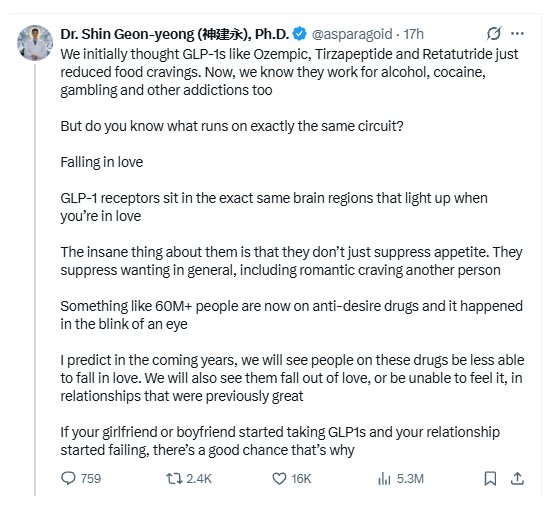
We initially thought GLP-1s like Ozempic, Tirzapeptide and Retatutride just reduced food cravings. Now, we know they work for alcohol, cocaine, gambling and other addictions too.
But do you know what runs on exactly the same circuit?
Falling in love.
GLP-1 receptors sit in the exact same brain regions that light up when you’re in love.
The insane thing about them is that they don’t just suppress appetite. They suppress wanting in general, including romantic craving another person.
Something like 60M+ people are now on anti-desire drugs and it happened in the blink of an eye.
I predict in the coming years, we will see people on these drugs be less able to fall in love. We will also see them fall out of love, or be unable to feel it, in relationships that were previously great.
If your girlfriend or boyfriend started taking GLP1s and your relationship started failing, there’s a good chance that’s why.
How about it, people? I’ve personally experienced the loss of interest in alcohol. Not the loss of love though. But love a couple decades in is different — experientially and presumably biochemically — than it is in the early years.
Your anecdotes in the comments are solicited. But remember, it’s all nonsense until they figure out how to do a rigorous scientific study. (Have they isolated the biochemical basic for romantic cravings well enough to do that study? I have not a damned clue. But I’m pretty sure a Korean plastic surgeon isn’t that far ahead of me.)
Similar Sex Blogging:
Shorter URL for sharing: https://www.erosblog.com/?p=34980

Ok, I’ll play.
A quick look around shows he might have something. I searched for oxytocin, the ‘love hormone’ and GLP-1 and found that there is a cocktail of the two being used for weight loss as there’s a synergy.
Which kind of confirms a hypothesis I’ve heard many times that people in love tend to lose their appetite, leading to weight loss. Which of course gets blamed on all that exercise they’re getting, being freshly in love and all that.
If oxytocin does indeed influence pancreas function in a positive way, then that’s a biochemical basis for that theory.
Conversely at the other end of the body, where oxytocin is produced as part of the process of falling in love, then there may be a negative feedback loop preventing over production of oxytocin, where GLP-1 is inhibiting production of oxytocin. Which if true would support the thesis that falling in love could be inhibited. Whether that is true is very dependent on molecular shape and interactions, but if they both work in one context, they may in another. A plausible theory, if untested yet. It should be possible to test.
Certainly when I’m with a lover I tend not to have much appetite, and when we’re apart I graze and snack, something I don’t do when we’re together.
So now explain feederism…