






August 25th, 2026 -- by Bacchus
A Man’s Idyll In The Marquesas
The pulpy adventure magazines of the mid-20th century made many a meaty meal and sold a whole lot of magazines by mixing travelers’ tales (highly unreliable fanciful narratives of faraway lands that no sensible person would credit) with a sort of Pacific-focused oceanic Orientalism that mythologized Pacific Island nudity and sexual generosity. This illustration comes from one such article titled Girls Of The Marquesas:
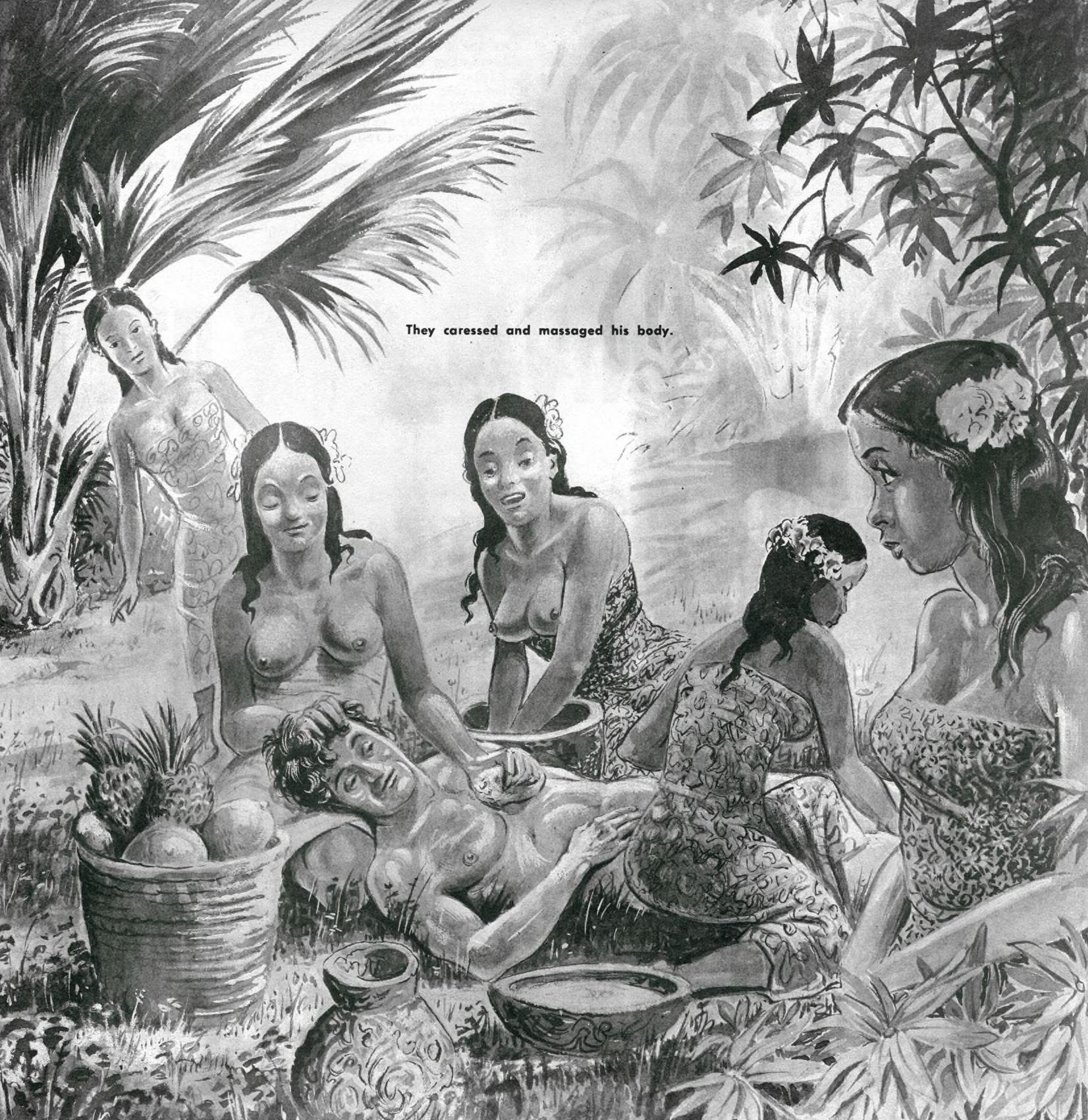
It is from the September 1960 issue of Rage magazine.
Similar Sex Blogging:
This entry was posted on Tuesday, August 25th, 2026 at 12:15 am. You can follow any responses to this entry through the RSS 2.0 feed. You can leave a response, or trackback from your own site.
Shorter URL for sharing: https://www.erosblog.com/?p=35781
Shorter URL for sharing: https://www.erosblog.com/?p=35781

I suspect there’s enough evidence of the ‘mythological’ Pacific Island friendliness in the history books to remove the mythological. Paul Gauguin, the mutineers from the Bounty are just two examples that come immediately to mind as examples of Tahitian hospitality.
However by the time the articles and images you refer to were published I’d say western prudism had destroyed the cultures concerned and rendered them fond memories and contemporary mythology. A modern visitor to those islands will probably be met with tourist traps set in modern monoculture. Truly a loss to the world. Though the Polynesian cultures tended to blend that hospitality with a very dark and brutal violence. Not just to western visitors, see the Chatham Islands for example.
Why in the world do they not think about the situation??
The second woman is wearing a dress that comes up to just below her boobs. Huh??
Finagle, by now you should know my work well enough to expect that when I am discussing touchy subjects that implicate issues like racism and colonialism, my language is careful and intricate for a reason, and if you take issue with a word I didn’t use (“mythological” instead of “mythologized”) or if you disassemble one of my deliberately-intricate phrases (here, “Pacific-focused oceanic Orientalism that mythologized Pacific Island nudity and sexual generosity”) you’re at risk of finding yourself arguing against points I never made. In this case I was careful not to take a position on precisely how much truth lies at the heart of those unreliable and fanciful mythologizing accounts. Because I don’t know. I wanted to flag for the reader that essentially all 20th-century discussion of the matter — certainly if found in pulp magazines for men — is unreliable and untrustworthy, which is not precisely the same as being false in every particular. I think the phrasing I chose accomplished that.
I was just giving examples that back in the day there was a factual basis, before agreeing that by the 60s that was fond memory only. And I agree, definitely never trust anything absolutely without checking other (preferably primary) sources, whether in a gentlemans periodical or not.
Jon Pertwee, Dr Who as was, was in the Navy during WWII. He told of refusing a request from the Free French for a volunteer to an overseas posting, then after the war meeting the person who accepted it, who told him the position he declined was attache to Tahiti, with a salacious smirk.
Jared Diamond is a worthwhile author to consult about anthropological matters, especially an unbiased view on colonialism. Should you be so inclined. I warn you though that some of his work is hard to stomach at times.
and yes, I did misread your words at least twice, seeing mythological not mythologized. I’m finding I do that as I get older, and it worries me not a little.
I think it’s wise to regard the work of Paul Gaugin and others as art rather than accurate historical record.
The French state was scandalised and thrilled by its overseas territories, and sent missionaries to ‘save’ the children of these islands from their native culture.
Meanwhile, Gaugin was sexualising children and trying to develop a market for his paintings. He was, in modern parlance, a paedophile.
All this suggests that the alleged free and open sexuality of Tahiti and the Marquesas was exaggerated for a French domestic audience.
The points that I was trying to make were that the traveler’s tale is an ancient literary device in the western canon — an enticing story framed around exotica that’s so far away that the reader will never have any hope of verifying with their own eyes. Orientalism — or in the this case, oceanic orientalism — is an academic term that focuses on specific ways Western colonialism and racism warps how we engage with the distant exotic other. Mix the two together, and you get a ripe stew indeed. I’m sure it’s a fine hobby for somebody to try and spot bits of actual true history in that stew, but it’s like watching the animated Disney Robin Hood movie and looking for accurate historical facts about British outlaws. Don’t get too invested!
Hey! Are you telling me Sir Hiss is hisssstorically inaccurate? Just like Disney to go ‘python’ on our cultural icons.