|
|

The Sex Blog Of Record
ErosBlog posts containing "pornocalypse"
March 25th, 2016 -- by Bacchus
Here’s another great reason to love the internet: a large digital collection [gone now, here’s the Wayback machine URL proving I didn’t dream it] of On Our Backs, the lesbian magazine from the 1980s and 1990s (I’d call it “seminal” if that word weren’t so manifestly unsuited to carrying the freight I need carried) published by, among others, Susie Bright.
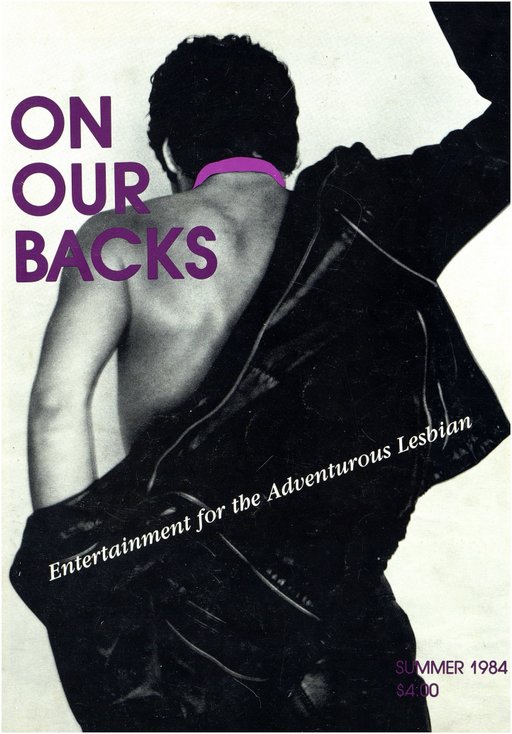
The collection is from Independent Voices (“an open-access collection of an alternative press”) and though it doesn’t claim to be complete, it is very substantial, containing 68 issues of the magazine. (Gaps in the collection are evident from the numbering, but how many of them coincide with publication gaps is something I can’t easily check.)
Enjoy!
2019 Update: I’m sorry to report that Independent Voices has removed public access to the On Our Backs collection, for stated reasons that strike me as reflecting either cowardice or insincerity. It can be humiliating when the #pornocalypse comes for you, and not everybody is willing to admit when it happens.
Similar Sex Blogging:
November 10th, 2015 -- by Bacchus
I am possessed of a very bad habit. Sometimes I write hectoring letters of advice to complete strangers, in which I tell them how to run (or how not to run) their businesses. Do I actually know how internet strangers should run their businesses? Probably not. Thus, the people who get these letters of mine may conclude that I am a complete crank and net-loon. It’s possible they’re right.
In my defense: I’m getting better! Decades ago, I needed less provocation. Once in the early 1990s, the owner of a small dialup ISP sent me a polite email asking me not to be dialed-in from work and from home simultaneously. (I was in fact running multiple “news robots” against his company’s NNTP server, downloading lots of porn from Usenet.) I apologized, and with the apology sent him many paragraphs of enthusiastic opinion about his business and how it could (from my perspective as a happy power user) be improved. He took my feedback positively, wrote back in good humor, and we maintained a friendly email correspondence for some years, until he sold out to a telecoms giant and went off to Silicon Valley to play startup games with the big boys.
Before the internet, I had a job where I would sometimes write a “micro memo” on a single sheet of paper to summarize and transmit an important press clipping to my bosses, along with a couple of sentences about why it was important to our business. Sometimes I would write these opinionated little micro memos as fax cover sheets and then fax them to random members of my local business community who I thought might need the clippings (and my opinions). They might respond with gratitude, or with confusion; mostly they didn’t respond at all. I justified the effort as “business development” but mostly it was just a cranky hobby. My joke with my friends and colleagues was that I was running a charity business consultancy. Free business advice! (That you never asked for — uh, sorry.)
I told you: I’m getting better. These days, it’s mostly people who write to me first who are at risk of getting an unsolicited session of free business consulting. Usually they are asking for something like marketing help or free exposure, but they make the mistake of pretending they are asking for my advice or feedback because “Please have a look at my stuff and tell me what you think” sounds better than “Please have a look at my stuff and then blog about it for free.”
On the list of recent victims: the perfectly nice folks who run Mikandi, the adult app store for Android devices. Several of you have asked me why I did not blog about the excellent article in Wired magazine last month called The Porn Business Isn’t Anything Like You Think It Is. That article featured, among much other excellent stuff, profiles of Mikandi’s Chris O’Connell (chief architect) and its founders, Jesse Adams and Jen McEwen.

Porn and smartphones are a natural mix. I called Steve Jobs an asshole (until I had to transition to metaphorical spitting on his grave) for inventing the smartphone and then for locking it up so tight that porn apps can’t practically be installed on it by a typical user. Android looked better to me when it came along (this was back when Google still took a stand against being evil) but when Google entered its modern “fuck it, evil pays better” phase, they locked porn out of the default Android app store too. Mikandi (“the app store that treats you like an adult”) stands against all that, and runs what everyone says is a fine adult app store for Android. I want to like them for that, indeed I do like them for that, and I’ve been saying positive things about them for awhile.
I am not, however, a Mikandi customer. The reason for this is embarrassing and economic. I get free iPhones from a family member who wound up on the “Oooh, shiny!” Apple early-adopter treadmill, and so they give me free barely-used phones on a regular basis. I’ve never owned an Android device because of my endless supply of free IOS ones. It’s OK. I get plenty of porn on my desktop, I guess I don’t really need it on my phone, too.
But still. In theory I’d rather be an Android user, and if I were one, I’d be a Mikandi customer too.
Back in June I got a nice email (a real letter, not just a form template) from Jennifer McEwen at Mikandi. She identified herself as co-founder and VP of Product Development at Mikandi, she reminded me that we’d chatted on Twitter via their company account (@mikandistore), and she wanted to “share with me” that Mikandi had officially released its feature supporting the sale of adult comics as apps in the Mikandi store. She invited me to take “take the comic reader for spin” and offered to set me up with some free Mikandi Gold (presumably Gold is their app-store currency) to facilitate that.

She didn’t expressly ask me to write about the new Mikandi product line here on ErosBlog, nor did she explicitly ask me to tell her what I thought of her new offering. Nonetheless I assume she wanted at least one of those. My guess is that she wanted something like what Violet Blue gave her over at Tiny Nibbles: an enthusiastic and visually-appealing blog post saying nice things about the Mikandi comics publishing platform and about the hot dirty sex comics you can enjoy there.
Surprise, dear reader: Jennifer McEwan from Mikandi did not get that from me.
Nope, she got the detailed feedback on why I don’t think her business model is a good one for adult comics publishers. Whoopsie…
Y’see, I have issues with the media-packaged-in-an-app business model. I also have issues with simplistic policies about depictions of consent in porn, and it turns out that Mikandi’s policy is cartoonishly simplistic:
“MiKandi does not accept any non-consensual material, actual or implied. Consent is sexy!”
Reader, I shared my issues with Jennifer. I totally did. Here is an edited-down (yes, really!) version of what I wrote to poor Jen:
Hi, Jen. I’m actually quite glad to hear from you! I’ve become rather a big fan of Mikandi based on your fundamental market positioning and blog postings. (Although I am in theory a big fan of the more-open Android platform and its potential to allow adult products and services that Apple bans from the IOS world, the sorry truth is that I am an IOS user. Thus I don’t actually have an Android device in the house, which means I don’t have the familiarity with your platform and business processes that I would like.)
Sadly that means I’m afraid I have to decline your kind offer of some test Gold — an offer which I would otherwise accept with alacrity.
I must confess I find myself less than excited about your new comic book publishing platform, although I expect a great many comic book publishers will find benefit in it. My concerns with it are at least
partly philosophical: I see a distinction between software (like games and such) and media (like comics). Although I’m not happy buying software that has the potential to get DRM-bricked upon failure of the platform (years pass, the platform gets acquired, the servers stop responding, the app phones home, no answer, so sorry, you lose) I’ve mostly resigned myself to it. But when it comes to media, I am extremely old-school about my purchases. Basically if I can’t load it into my Calibre library (as I do with ebooks), convert it to whatever device-specific format I’m using this week, and then side-load it onto my devices, I’m not going to shell out good money for it. I realize this makes me a crusty curmudgeon. Nonetheless I have all good wishes for your venture; I’m just not excited about this specific business model of shoving media into app-wrappers that need to phone home periodically.
I’ve also got concerns about your Terms Of Service regarding non-consent content, as you were discussing on Twitter yesterday with @eroticawriter. I fundamentally understand that your interface with the banking system leaves you very constrained, but a 10-word policy from 2011 is simply way too vague. If you can’t get more certainty out of your CC processor, you’re not ready to release the platform; and if you HAVE gotten more specific terms regarding what the CC processor will tolerate, those terms ought to be revealed to potential developers.
We all know you don’t want (and the banks won’t process for) endless reams of rape manga, but I am imagining some comics producer like my friend Dr. Faustus who publishes his Tales of Gnosis College comics in old-fashioned comic-book-sized segments, where a plot-essential rape scene might theoretically show up for the first time across four panels in the middle of the seventh book. Indeed, Dr. Faustus does have several sex scenes scattered throughout his comic books, some of them featuring bondage, wrestling, complicated inducements, complicated risk environments, and other complex circumstances that might call consent into question. He avoids the squeamish-publisher problem (and many others) by releasing everything under GPL for free, but I feel like a for-profit publisher trying to distribute an ongoing series via your platform would be put in a terrible bind. Either they have to abandon your platform or they have to decide that artistically, they can’t go where the series otherwise needs to go.
Asking publishers to work in that sort of chilling-effect environment, it seems to me, requires offering them more than ten words of guidance about what is and is not allowed. This is especially so in the case of comics. What does consent even mean in the context of brightly-colored line drawings? It would be fairly easy to exclude material where the fact of rape was the deliberately-titillating fetish element; you could exclude material that advertises rape in titles or summaries, contains dialog or visual elements making the lack of consent explicit, and so forth. But you can’t do it in ten words, and it’s not fair to do it at all without also including some sort of guarantee that a publisher will get a warning or a pre-review process or an opportunity to discover where the line is without being summarily ejected from the platform.
I assume Mikandi is good to developers and publishers because that’s the impression I get about your overall approach to business; but so many #pornocalypse-ready platforms have burned so many people with irregular bannings and subsequent refusal to engage or explain! I would advise any would-be publisher of adult comics not to adopt or invest resources into building out on a new platform or marketplace unless the people running the platform make a public and contractual commitment to providing what is called “due process” in the legal realm. No arbitrary bannings, no unexplained bannings, no loss of ongoing access to the platform because of a transgression that is deemed to exist at the platform’s discretion based on policies not fully disclosed or not even fully-defined internally. It may be (and I hope!) that your internal process incorporates all of these publisher protections, but if so, your documentation doesn’t hint at them. We know you’re adult-friendly, but if the underlying reality is that you have to completely dump some long-running publisher without notice or warning because you got an unhappy phone call from a banking executive, all your good intentions are not so useful. If all of the app-wrapped comics that publisher has sold then suddenly stop working (I have no idea if this risk exists, another “reassurance opportunity” not yet seized by your documentation) it becomes a calamity for readers as well as publishers.
I apologize for turning this into another one of my #pornocalypse rants. I know from your twitter responses yesterday that you’re sensitive to at least some of these issues, and that you’re operating under billing constraints that you can’t do anything about. But I’m very passionate about advising adult-industry people not to get invested in platforms that don’t have their backs. I’m pretty sure you WANT to have the backs of the people who publish through you, but it’s unclear from the TOS whether you’ve got the necessary procedures in place, or the necessary freedom negotiated with your billers, to actually offer publishers what they need: clarity, certainty, and security from arbitrary business disruption when the limits of clarity and certainty have been reached or passed.
Finally, consent issues are at the emotional heart of a lot of BDSM fantasy literature, including in adult comic books. Ambiguity about consent is part of that, whether the ambiguity arises from the limited information available to a third-party viewer (if the opening panel is a handcuffed character fucking, we just don’t have facts to answer the consent question) or whether it arises in the notional mind of the character. (Are they undecided? Have they changed their mind since inviting the handcuffing, but not said anything? How do we know? How would we ever know? Since the mind we are interrogating doesn’t exist, what do these questions even mean?) It seems to me that there’s just a huge realm of adult “comics” literature that is just INCOMPATIBLE with your current ten-word policy on consent. It’s not because non-consensual themes are predominant, but simply because there’s no way to evaluate the work against the 10-word policy and reach any kind of sensible, predictable, or reproducible answer.
Oops! Ranting again. I’ll stop now. Please believe me when I say that I love what I can see of what y’all have been doing, and I’m delighted that your platform exists to challenge the prudishness of Apple and Google. Whatever my reservations about the current offering, I want to see Mikandi thrive and grow and prosper.
Thanks again for getting in touch!
She never wrote me back, poor woman. And what’s more, I don’t blame her. In her shoes, I would have have carefully closed the email from the internet crazyman and gingerly deleted it from my inbox.
How not to be an e-commerce business consultant? I am totally your dude for that!
Similar Sex Blogging:
June 1st, 2015 -- by Bacchus
Here’s an interesting story that I missed in late April on the Mikandi blog:
The latest hit to companies who are actively anti-sex industry is a lawsuit against the payment processor Square. Xbiz reports that attorney William McGrane is taking them to court with the claim that the 27 business categories in Stripe’s “Prohibited Businesses” are being discriminated against and having their civil rights violated under the policy.
According to McGrane, the majority of the types of businesses listed are either too vague to be valid or are legal businesses, making it illegal forSquare to discriminate against them.
While the suit was originally filed on behalf of a bankruptcy law firm that was dropped fromSquare because “bankruptcy and debt collection” is also a prohibited category, anyone who works in a sex-related field who used Square but then was dropped may be eligible to be a part of the lawsuit.
The relevant section here is “Adult content and services,” which Square defines as “Adult entertainment oriented products or services (in any medium, including Internet, telephone or printed material).”
I like this because no matter how the suit comes out, the lawsuit itself establishes a cost for discriminating against adult businesses. If it gets expensive enough, these companies will have to narrow and tighten their policies, rather than engaging in sweeping discrimination against an entire legal business category. #Pornocalypse happens because of commercial pressures. If this suit is successful in establishing that Pornocalypse policies come with a quantum of legal risk, perhaps that will serve as some countervailing commercial pressure in the other direction.
Similar Sex Blogging:
April 15th, 2015 -- by Bacchus
Does anybody remember when, back in 2013, I blogged about how Tumblr was blocking selected adult links, in particular ones to a clip-sale place called Extra Lunch Money? It was a prior restraint sort of block; you’d hit the post button and if the offending link was present, you’d get a cryptic red “there was a problem saving your post” response.
My prediction back then was that Tumblr would, when caught, claim that the prior link restraint was a glitch:
Beginning during the negotiation of the sale to Yahoo, Tumblr’s practice has been to disadvantage its adult content in silent and hard-to-notice ways, even when that content was fully-consistent with its fairly permissive community guidelines. What’s more, when forced to backtrack by public outrage after the big robots.txt debacle, Tumblr went to great lengths to pretend it was all a misunderstood and unfortunate technical error.
So my prediction here is that if the link-censoring initiative attracts enough negative attention, publishing these links will start working again and Tumblr will either say nothing, or explain that it was all just a glitch. But if this story doesn’t reach critical mass, look for the list of disfavored adult links to continue to grow.
I was right. That’s exactly what happened. The blocked links quickly started working again.
Fast forward to yesterday, when Lady Amalthea posted an alert on her Tumblr blog about a sort of prior restraint that she’d noticed in attempting to post links to various cam sites and clip-sales sites:

Notice that one of her examples of a link Tumblr won’t let her publish is our old friend from 2013, that Extra Lunch Money site. And also notice that one of the people responding to Lady Amalthea’s post says that the block on her other example (My Free Cams) is not new: “Tumblr has never let me link to MFC, btw. That’s not a new thing in case anyone thought it was.”
So I fired up my Tumblr test suite and decided to focus on those two links and (as a control) the top link on her list of links that were working as of yesterday, a link to the clip site Clipvia. So far I haven’t looked at the behavior of any other links, just these three.
What I found is that whether you want to call it a “glitch” or prior restraint, at least some of the link-blocking behavior is definitely back. However, it may indeed be somewhat glitchy; I found that the behavior was inconsistent (not reproducible) as to at least one of the test links.
The first thing I tried was to create a new “Text” style post for each of my three test links, which I created by navigating to the home page of the three sites, copying the URL displayed in my nav bar, and pasting it directly into the new Tumblr post page before hitting the “Save Draft” button. At first, the only link that generated an error message was the one from My Free Cams:
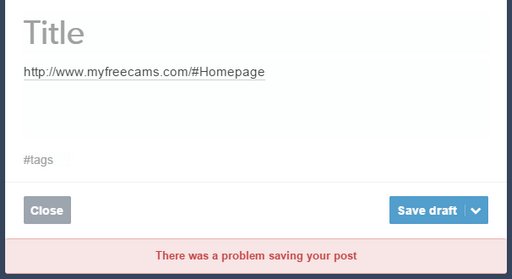
Although I was initially able to save more than one draft posts with the Extra Lunch Money and Clipvia links, subsequent attempts failed:


From there, I moved on to creating new “photo”-type posts. I would upload an image (the same in all cases), paste in the test URL, and attempt to save. In this case, I have not been able to get the Extra Lunch Money link to fail; it’s worked several times when I have tried this experiment:

However, my other two test URLs are not postable:
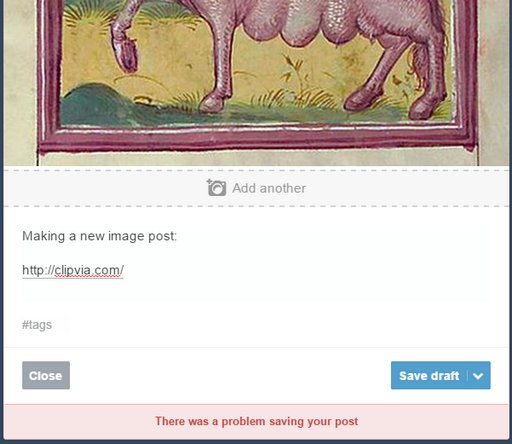

For my final experiment, I tried editing a post reblogged from someone else, and pasting in all three suspect links. In this, and several other experiments with reblogging, I was unable to generate the mysterious error message, and instead successfully saved my drafts:

My conclusion? If this is indeed a deliberate block of a set of blacklisted links, its implementation is glitchy, because the same link would sometimes post and sometimes fail to post for me. Its implementation is also glitchy across different post types and post actions. However, I don’t believe it’s completely random; there seem to be no reports of unpostable links outside this universe of sites used by camgirls and indy custom adult clips producers. I suspect that Tumblr does indeed have (and has had since at least 2013) a blacklist of not-to-be-published links. (This would even make sense if its use was restricted to protecting Tumblr users from malicious malware installers, to pick one obviously-legitimate use for a blacklist.) There might be an automated process (that’s gone wrong) for adding sites to the blacklist, or there might be a training-and-supervision issue that has let “rogue employees” add stinky adult sites to a list that was not intended for the restraint of adult publication. Given the way different attempts to post the same link have different results at different times, it’s even possible the blacklist is not universally distributed across all of Tumblr’s different server farms.
If enough Tumblr users report this “glitch” to Tumblr support, I expect that eventually the adult links they would like to publish will be removed from the blacklist, since the links do not violate any of Tumblr’s existing terms of service or community guidelines. That’s what Tumblr did last time, and they haven’t announced any new terms or policies (I checked).
Last time Tumblr was flirting with blocking selected adult links from publication, I wrote:
Tumblr is quietly and dishonestly hostile to adult content in general and to adult marketing and self-promotion in particular, even when that marketing complies with their community guidelines in every particular. Which is a nice intro to this morning’s sermon on The Catechism of Bacchus:
- Tumblr is, at the end of the day, a blogging service.
- As I’ve been saying since at least 2004, blogging services suck.
- This is Bacchus’s First Rule and it remains the rule: Anything worth doing on the internet is worth doing on your own server that you control.
- You will be tempted to ignore The Rule because of social media network effects.
- You may even feel forced to ignore it, because you can’t get enough attention on your own platform.
- When you disregard the rule (and everybody does, even me who wrote it) you will get burned.
- Count on it. Plan for it. The Pornocalypse Comes For Us All.
Nothing has changed since I wrote that.
Similar Sex Blogging:
February 27th, 2015 -- by Bacchus
Now that Google is spinning down the porn raid sirens and walking their shit back from last week’s announced intention to forbid “sexually explicit or graphic nude images or video”, it’s worth paying some careful attention the language used today by Jessica Pelegio, the social product support manager at Google. From her title, this sounds like the woman who is the boss of the people who will be enforcing the policy, so her understanding of the policy is likely to be supremely relevant. And in her announcement, she writes:
“We’ve decided to step up enforcement around our existing policy prohibiting commercial porn.”
The emphasis is mine. “Our existing policy prohibiting commercial porn.” What, what? Does Blogger even have an “existing policy prohibiting commercial porn”? Quick, let’s go look, and snap a screenshot before it changes:
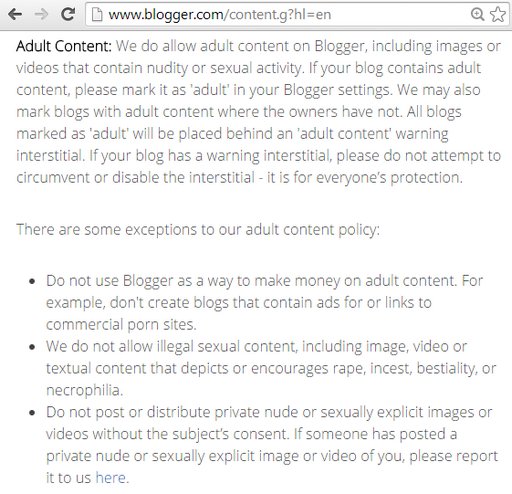
The key sentences for our purposes are:
Do not use Blogger as a way to make money on adult content. For example, don’t create blogs that contain ads for or links to commercial porn sites.
Strictly speaking, this is not a “policy prohibiting commercial porn.” One of the biggest categories of adult blogs on Blogger/Blogspot used to be a (what we would now consider to be Tumblr-style) constant flow of commercial porn, posted without links and purely for the amusement of the poster. You could squint and interpret the URL watermarks on commercial porn photos as “ads for…commercial porn sites”, but Google never did this (that we know of). The existing/current policy simply doesn’t prohibit commercial porn, though it might be said to prohibit porn posted with commercial intent. Does Jessica Pelegio think about the policy with that much nuance? Her phrasing today suggests: not so much.
But while we are parsing words, let’s fire up the Wayback Machine and have a look at how this “existing policy prohibiting commercial porn” has been phrased and characterized by Google since June of 2013 when Google dreamed it up.
Stepping back through time, we discover that between October 23, 2014 and November 6, 2014, they added one clarifying word: “ads or links to commercial porn sites” became “ads for or links to commercial porn sites.” Ads (in general) became ads (for commercial porn sites) so this narrowed the scope of Google’s prohibiting examples. Trivial, but cool. (At the same time as this wording change, Blogger added the current stern language prohibiting attempts to circumvent the interstitial adult warning.)
That takes us back (without any other changes I can discover) to the infamous June 30, 2013, when the current policy was implemented. (Here it is in the Wayback Machine on July 5th, 2013, so you an see for yourself.) Here’s the big announcement from then:
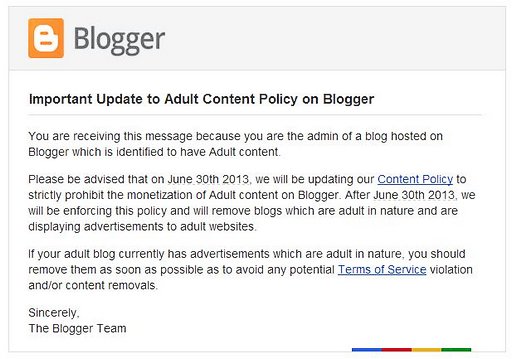
What Pelegio now calls a “policy prohibiting commercial porn” was then described as a new policy prohibiting blogs “which are … displaying advertisements to adult websites” or “currently has advertisements which are adult in nature.” That seems quite a bit narrower than the “policy prohibiting commercial porn” Pelegio now considers it to be.
For completeness, let’s compare the language before June 30, 2013 to the current policy. “Do not use Blogger as a way to make money on adult content” has not changed; that was been the policy since the earliest appearance of the policy page in the Wayback Machine on January 7, 2012. But before June 30, the prohibited example was “For example, don’t create blogs where a significant percentage of the content is ads or links to commercial porn sites.” The big policy change in June 2013 was going zero-tolerance on the ads and links to commercial porn sites — no more insignificant percentages allowed.
So, just to be clear: up until today, Google has always allowed commercial porn on Blogger/Blogspot, as long as that porn was not posted “as a way to make money on adult content.” Noncommercial use of commercial porn was fine, and before June of 2013, so too were de minimis links to commercial porn sites.
If the social product support manager is planning to “step up enforcement around our existing policy prohibiting commercial porn” when there currently is no such policy, for safety you should assume that either the policy will be changing or that the enforcement will hew to the manager’s view of what it means even when that’s not what it actually says. Neither is good news for the future of adult blogs on Blogger/Blogspot.
Sure, let’s all heave a sigh of relief that the March 23rd deadline is no longer looming. But don’t get complacent. If you’ve still got adult content on any Google property, get it out while you still can. Verbum sapienti satis.
Similar Sex Blogging:
February 27th, 2015 -- by Bacchus
Shortly after midnight last night, Google’s Social Product Support Manager Jessica Pelegio posted this semi-retraction of last week’s equally quiet announcement of the #Pornocalypse come to Blogger (Blogspot) blogs:
Hello everyone,
This week, we announced a change to Blogger’s porn policy. We’ve had a ton of feedback, in particular about the introduction of a retroactive change (some people have had accounts for 10+ years), but also about the negative impact on individuals who post sexually explicit content to express their identities. So rather than implement this change, we’ve decided to step up enforcement around our existing policy prohibiting commercial porn.
Blog owners should continue to mark any blogs containing sexually explicit content as “adult” so that they can be placed behind an “adult content” warning page.
Bloggers whose content is consistent with this and other policies do not need to make any changes to their blogs.
Thank you for your continued feedback.
The Blogger Team
This is good news. You might even say it means Google is listening. But I think we can all take away from this a much clearer sense of Google’s corporate direction on adult material.
Smart people who are still using Google’s services for adult content distribution will now, of course, stop doing that. The next time, consequently, there will be less outrage and less backlash. Which means that when Google finally does move to delete the tens of thousands of moribund adult blogs that it threatened to delete this time, only cranks like me who see that material and the links to it as socially valuable will complain.
Note also that this announcement’s breezy summary “our existing policy prohibiting commercial porn” is substantially more broad in scope than the actual policy as of today, which prohibits making money on adult content but which is fine with just posting (for your own enjoyment) as much commercial porn as you want:
Do not use Blogger as a way to make money on adult content. For example, don’t create blogs that contain ads for or links to commercial porn sites.
Don’t be surprised if that wording changes, or if blogs full of commercial porn posted for fun start to disappear. Bets on whether the URL watermark on a commercial porn photo will start being treated as “ads for” commercial porn sites? Of course we’ll never know, because these deletions will not be accompanied by specific reasons, fleshed-out policies, or any meaningful human review or appeal.
But yeah. The Google porn raid siren has gone quiet again for now. Come out from under your desk, breathe a sigh of relief that the bombers aren’t coming on March 23rd, and then move your shit somewhere safe before the next time the damned porn raid sirens go off. Or as A.V. Flox puts it rather more eloquently at Slantist:
We tell ourselves “once on the internet, always on the internet,” like maintaining content is a trivial thing. But it isn’t a trivial thing – at any time, the company that you rely on to keep your content for free could change their policies, or get bought out and change their policies, or decide they want to go public and change their policies, or simply go under and take your content with them.
The longevity of data requires more intent than this. My advice is to seriously consider migrating to a self-hosted site if you can. If you can’t, make sure you export your data with some regularity.
Think of this as your 21st century reminder of a duck and cover drill. DEFCON has gone back up, but the Cold War on adult is far from over.
Similar Sex Blogging:
February 26th, 2015 -- by Bacchus
Subtitle: How To Tweak Your Robots.txt File So That The Wayback Machine Will Show The World What Google Refuses to Display
One of the reasons the adult internet will take such a hard body blow when Google makes sexually explicit Blogger (Blogspot) blogs forcibly private on March 23 is that in a single moment they will break millions of links around the web. As Violet Blue puts it:
When Google forces its “unacceptable” Blogger blogs to go dark, it will break more of the Internet than you think. Countless links that have been accessible on Blogger since its inception in 1999 will be broken across the Internet.
What’s your reflex response when you follow a link and find it broken? If it’s like me, you immediately click the link on your bookmarks toolbar that takes you to the WayBack Machine at the Internet Archive: https://archive.org/web/
The Wayback Machine and the Internet Archive’s crawling robot are powerful tools. Like all powerful tools, exactly how they work is sometimes obscure. Here are the basics: The IA crawler bot crawls the web, visiting as many pages as it can manage. And it stuffs those pages into the huge databases of the Wayback Machine, where the pages are preserved for all time, or anyway for as long as the Internet Archive can manage).
Preservation, however, is not the same as sharing and display. Some of the pages the Wayback Machine has in its databases are not displayed to the public. The reasons for this are covered in a complex FAQ, but for our purposes it’s enough to understand that sometimes when the IA crawler bot encounters a robots.txt file on a domain, that robots.txt file in effect tells the bot to go pound sand while pissing up a rope. And when the bot finds such a robots exclusion request, the bot politely backs away from the crazy person and (supposedly) refrains from capturing the current version of the pages. (See also: ROBOTS.TXT IS A SUICIDE NOTE)
In such a case (for reasons) the Wayback Machine will stop displaying any of the pages “protected” by the robot exclusion request. Any user requests will get this ugly red error instead:
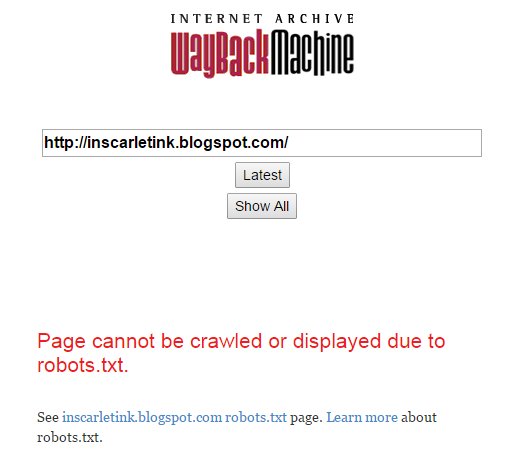
That’s so even if the IA bot has been to these pages a hundred times and has years of history in successive snapshots of the pages. If the robots.txt exclusion is present, the Wayback Machine refuses to display any of that old crawl data.
But note carefully what that explanation (and the Archive.org FAQ) does not say. The Wayback Machine does not display those old pages it still has in its database — but it certainly does not delete them from its database, either.
The Internet Archive and The WayBack Machine are not in the business of deleting shit. I take it as an article of faith that they for damned-skippy-sure never delete anything just because of a few lines in a robots.txt file.
Nothing on a website is there forever. That includes obnoxious robots.txt files. And when the robots.txt files go away, suddenly those old crawled pages become visible again. I actually saw this happen after Tumblr reversed itself in 2013 and at least temporarily stopped forcing a hostile robots.txt file onto its adult bloggers. The hostile robots.txt files stopped being so hostile, so the Wayback Machine could once again display the old pages that it had crawled and displayed upon request prior to Tumblr imposing the robots.txt files.
Consider now an adult Blogger (blogspot.com) blog that’s already private, because the owner chose to make it that way. Here’s the robots.txt file that Blogger displays by default:
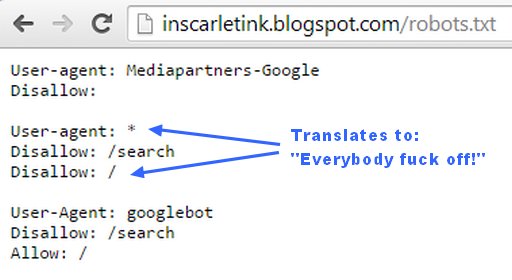
There’s a good chance (if only because Google hasn’t telegraphed any planned changes to the functionality of its private Blogger blogs) that this same exclusionary robots.txt will appear for every sexually explicit Blogger blog that is forcibly flagged “private” on March 23.
So, if you have a sexually explicit Blogger blog right now, there’s a good chance it’s in the Wayback Machine already, in whole or in part. (You can check: go here and paste your URL in the box.)
Now let’s fast forward to March 24th. Suppose I notice some old ErosBlog post that links to your Blogger sex blog. I click the link and it’s now broken, because Google has forcibly set your blog to “private”. If I ask the Wayback Machine to show me the old page for the broken link, I’ll get the ugly red error. But the Internet Archive still has that old page in its database. And someday, when things change, the Wayback Machine could theoretically serve the old page once again. (Google might change its policy. The Internet Archive might change its policy. Google might have gone bankrupt, or sold the Blogspot.com domain to America Online. The Internet might have changed beyond all recognition. The horse might even learn to sing, we can’t know.)
From a practical standpoint, this fact that the old pages of your blog are still in the databases of the Internet Archives — but barred from public display — doesn’t help us much. But if you feel that your sexually explicit blog is a legitimate part of the cultural history of the early 21st century, it matters rather a lot. Because your blog is not lost to history — it’s just lost to those of us who are interested in it right now.
(Yes, I am assuming that the Internet Archives will be successful in preserving and transmitting its data — our data — into the deep future. That’s by no means assured. If you have oodles of spare money kicking around, giving them some of your oodles would no doubt help assure it.)
Thus this post is, in part, a “don’t panic” message about all the sex blogs that are about to disappear from the internet. I called it a “hard body blow” at the top of this post, and it is. But it’s not a fatal blow. Yes, it will break a ton of our links and create a big dark hole in our adult internet. But it won’t, if the gods keep smiling on Brewster Kahle and his people, disappear those old blogs forever.
But I wouldn’t be well over a dozen paragraphs into this huge wall of text if all I had to say was “don’t panic.” Here’s an interesting thing that I just discovered about a blog on Blogger: Google currently allows blog owners to set the contents of their own custom robots.txt files, even on blogs flagged as private.
You can log into your adult Blogger blog right now and set a custom robots.txt file. If you want the Internet Archive to keep displaying archived pages once Google breaks all your inbound links, set it like this under Settings – Search Preferences – Crawlers and Indexing:
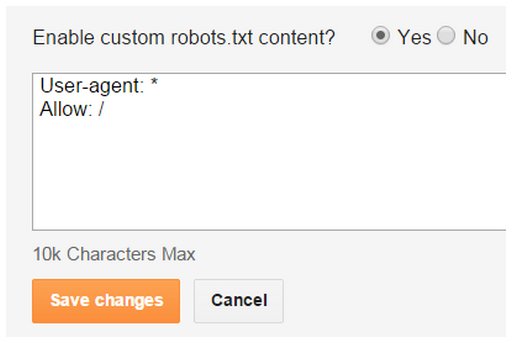
It can’t hurt anything, and it might mean that all your broken links can be “repaired” by people who encounter them. They will just paste the broken link into the Wayback Machine and be served a copy of the page as it used to be before Google went insane.
Will it work? Well, we don’t know for sure. Google could easily impose a uniform and restrictive robots.txt file on its adult bloggers after it forces them into “private” mode, by ignoring the custom setting or by removing it from the Blogger interface altogether. But — by design or oversight — Google might not do that, either.
If this trick does work, it means there will more traces remaining available to the public of your years of explicit sex blogging. And people who are bitterly disappointed by broken links to your stuff will have at least one useful thing to try.
Hopefully you’ll be taking more direct action too, like migrating your blog to private hosting. But if you can’t spare the resources to do that, this custom robots.txt change is a little thing you can do that may help a little.
P.S. If you have some technical skill and want to take a more proactive approach to saving our erotic cultural history, Archiveteam (these are the folks who saved Geocities, who also want you to understand they are not the Internet Archive) seems to have taken the news about Google’s erotic blog freakout as a sign that Blogger in general is no longer to be trusted. Because they have now announced they are “downloading everything”. This is great news, but it’s a project of epic size, and they can always use more help.
Similar Sex Blogging:
|
|